what should i use to bed my stanchins on y sailboat
Sealing Deck Penetrations To Forbid Core Rot
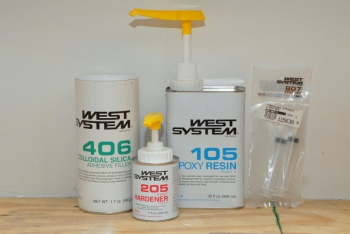
The Epoxy Supplies
Most all boats have some sort of "core" in the decks. Whether it's balsa, plywood or some of the foam cores all can eventually blot water from a leaking deck penetration. A leaking deck, especially with woods cores, tin can atomic number 82 to core rot and somewhen delamination of the deck and loss of structural rigidity.
Sailboats especially can accept hundreds of holes drilled into the deck for cleats, stanchions, blocks, winches, genoa tracks or many other mechanically attached and through bolted or screwed in items.
Unfortunately almost builders exercise not take the time, nor have the patience, to protect the core from moisture. Nigh builders too fall short in their bedding techniques, choosing in favor of cost cutting mensurate that you lot get to deal with a few years beyond the warranty. The "can't be seen, must not be in that location" mentality certainly rings true in the category of deck hardware installations.
The re-bedding of deck hardware is a time consuming task but one that can salvage your 5, 6 or seven effigy vessel from loosing 25% to 50% of it's market value due to saturated and rotted decks. There is no method improve than potting the holes with thickened epoxy to prevent core damage, if yous have core where hardware passes through it. This projection is easy but also quite fourth dimension consuming. Once done correctly yous will never have to worry about h2o getting into your cadre again.
These are the epoxy products I often utilise to pot deck holes. I sometimes use Organisation Three Epoxy products too but for this article I used West Organization. Westward Arrangement epoxy products are very easy to notice and use. I employ a #205 hardener #105 resin & Colloidal Silica or "Cabosil" as the filler or thickening agent.
In club to inject the resin into the holes I utilise the West Organisation syringes.
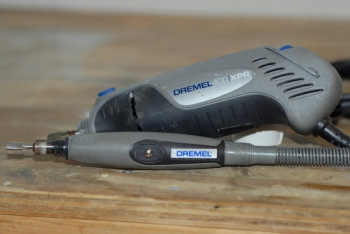
A Dremel With Remote Wand
A deck cadre is a sandwich of fiberglass skins laminated to a cream, balsa, constructed or plywood cadre. In club to "pot" a hole you lot must first remove a modest amount of core from between the skins. I ofttimes read of the "bent boom and drill" for this chore but it's not a pretty or an like shooting fish in a barrel task unless the core is already rotten. I oft find myself questioning whether the authors or folks recommending this practice accept actually ever tried it, but I digress.
While I accept chosen to illustrate this using a balsa core you should be enlightened that most builders exercise not use a foam or balsa core directly below high load deck hardware. Generally you'll be dealing with marine grade plywood under deck fittings. Plywood can handle the compression loads far better than either balsa or foam cores and this is why it'due south very often laminated into the deck beneath deck hardware. Plywood, if dry, is a hard core to carve out and is yet ane more than reason why the bent blast trick is non as easy as some would arrive seem.
The easiest way to remove the core from between two skins, that I have found, is with a Dremel. I also advise the apply of the magic wand as I similar to telephone call information technology. This flexible Dremel extension gives you lot artist like finesse and makes the job of removing core material significantly easier. Rotary tools are very inexpensive these days and I can't imagine owning a boat without one, especially when potting deck core penetrations.
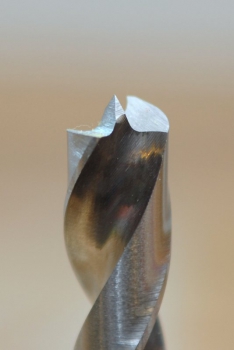
Brad Point Drill
When drilling into fiberglass the proper tool is a must. This is a brad point drill and information technology will create a clean, no chip hole in gelcoat provided you employ a few tricks.
TIP: The main pull a fast one on with brad points into gelcoat is to first the drill in opposite. This pull a fast one on also works well with hole-saws. By starting in reverse it allows the outer cutting edges of the drill to cutting cleanly through the gelcoat. In one case through the gelcoat you tin so switch the drill to frontwards and complete the hole without chipping any gelcoat off the surface.
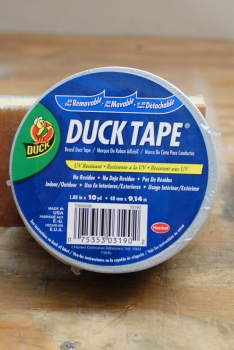
Tape For Sealing The Underside of The Deck
This is may favorite marine duct tape. It'due south a UV stabilized, white in colour, heavy duty duct tape fabricated by Duck brand. It is hard to find but I have establish no better duct tape, in white, that is also UV stable for use on a boat.
I use this tape to seal off the underside of the deck. This prevents the epoxy from dripping into the motel. Gorilla Tape is even better for this as it is even more adhesive.
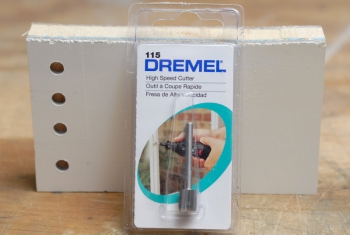
Dremel Flake #115
This is ane of two bits I use to remove the core. It is a 5/16″ diameter caput with a 1/8″ shank. Information technology allows a just correct amount of core removal to seal the deck from moisture.
Dremel Bit #654
This is my other favorite bit the Dremel #654. I similar this ane because most hardware, like stanchions, on 28-42 human foot sailboats, is through bolted with 1/4″ Ten twenty or 5/16″ X xviii thread bolts. The head of this fleck is one/4″ and it fits downwards into a 1/iv″ hole and can then exist used to remove core without outset over-drilling the superlative skin to 5/xvi″.
TIP: I prefer to go out equally much of the acme and bottom peel in identify as is possible. Much of the strength of the deck comes from these skins so leaving them intact when potting a pigsty is the ta good practice. Leaving the peak and bottom skins intact, without over drilling all the fashion through both skins, leaves you with a captured plug of epoxy that can't physically pop out or break free as hands as a complete over drill of both skins can. Of course if proper backing plates are used this should not exist a issue.
Either method, over-drill or leaving the skins intact, is arguably much better than not sealing the core at all. Don't fret over the method simply chose i and practice it before information technology's too late.
Enlarging An Existing Hole
In social club to complete this article I used a chip slice of end grain balsa deck structure. I wanted to use a flake piece so that I could make cut-a-ways to bear witness the inner workings and what actually happens on the inside of the deck.
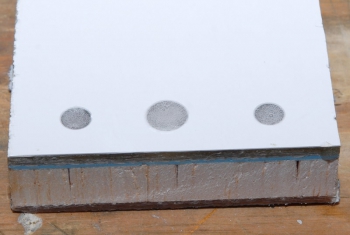
Here I've drilled three holes;
- I hole for the #115 bit,
- One pigsty for the #654
- One hole that will remain as i/4″ with no epoxy fill up.
The heart pigsty, equally you can see, has been counter sunk. This was originally a i/iv″ hole that I over sized to v/16″ to brand the #115 scrap fit into it. Over sizing holes in fiberglass tin oftentimes result in an "oops" and some serious deck chipping.
TIP: Here'south the trick to over sizing holes:
#1 Countersink/chamfer the pigsty to merely barely beyond the width of the drill you lot will use for the over sizing, in this instance 5/xvi″. If your countersink chip is new and sharp get in the habit of using opposite, not forward, when countersinking fiberglass. Frontward volition remove too much cloth, far too fast, if you are not careful.
#2 Place your brad betoken drill in the chamfered hole and offset in reverse. You will cutting through the summit peel only and accept a nice clean hole. You do however need a brad point drill set. You won't find them at Home Depot and will find them a Rockler or on line. This is the quickest and cleanest way to bore the acme pare without the drill wandering or causing serious gelcoat chipping.
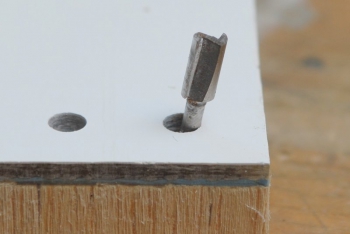
The Fleck Fits
Equally you can see (click the image to get in bigger if you can't) the five/16″ head of the Dremel #115 fits into the recess created by the countersink. I have purposely created a little extra room with the countersink to 100% avoid edge chipping.
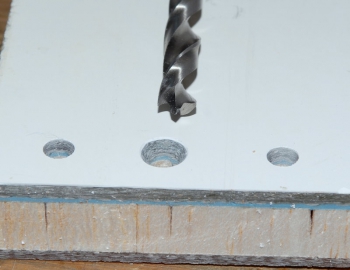
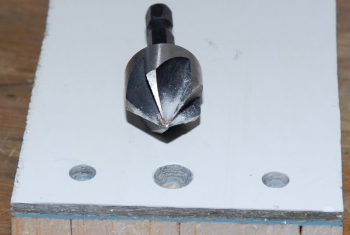
Drill For Making Over Sized Hole
Here's my 5/xvi″ flake that I used to enlarge the pigsty on the top skin. Once more, practice not drill all the style through the deck merely drill through the top peel.
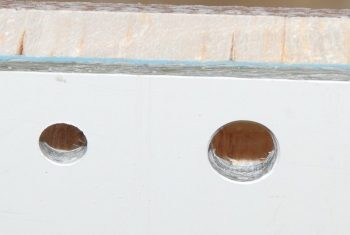
A Make clean Edged Over Sized Hole
This epitome shows the five/16″ over sized hole, and the original 1/4″ hole on the left. The new bigger hole is only as clean, even though there was no center point to beginning the drill with.
At this point I've removed the cadre with the Dremel and y'all can see the crenel it created, if yous accident upward the photo and look close.
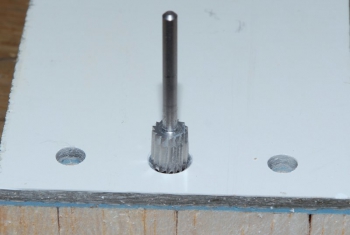
When using the Dremel to rout the core away make it a practice to insert the caput of the scrap into the deck before turning it on. One time turned on use the $.25 shaft as a guide and work your way around the hole moving up and down and around the circumference of the deck hole to make clean the core material from the the skins and make a nice, even, circular cavity for the epoxy to seal the deck. Brand a few passes and suck any dust out with a shop vac. It takes all of about x-20 seconds, per hole, once you're prepped and ready for it..
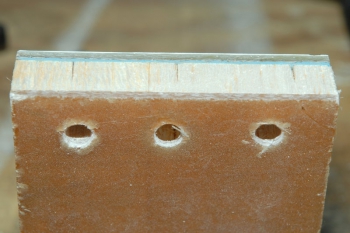
Bottom Holes
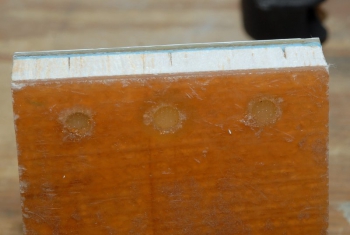
This photo illustrates that all the holes beneath deck are still ane/iv″ fifty-fifty though the centre hole has a five/xvi″ diameter on the decks surface. This leaves as much of the deck skins intact is every bit humanly possible.
Mix Epoxy
Now that the cadre has been routed out with the #115 & #654 bits it'south time to mix some epoxy.
W Systems, and well-nigh others, use metered pumps to make mixing near as easy equally information technology gets. Until you get good at it I don't recommend using partial pumpsouth. Apply full pump strokes for the proper mix ratio. The mixing ratio for West Arrangement is one full pump stroke of hardener to i full pump stroke of resin. You will take about 20 minutes of pot life using the 105 resin and 205 hardener at temps in the depression to mid sixties, which is plenty. At room temp, 72 degrees, you'll have 9-12 minutes of workable pot life.
Epoxies kick off faster when information technology's warm and slower when cold. If working in colder conditions call back that it volition become more gummy and tougher to work with specially when you need it less viscous to fill deck holes.. For more info on using West Arrangement epoxy visit their great and informative web site.
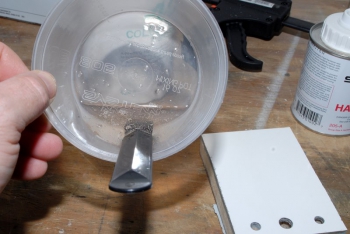
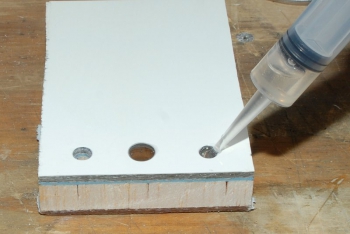
Inject Non-Thickened Epoxy Showtime
I know I said "thickened epoxy", and we'll go there, only first it's a good idea to inject clear mixed non-thickened epoxy into each hole. Past doing this you allow the less viscous, resin just, without thickener, to penetrate the surface pores of the cadre. this creates a better and stronger last bail.
In club to exercise this I inject straight mixed epoxy into each hole with a syringe. I then allow it sit in each hole for well-nigh 3-4 minutes, suck it dorsum out with the syringe and then squirt information technology back into the mixing cup where I add together Cabosil (colloidal silica) to thicken it.
Mix In The Cabosil
Adding Cabosil, or the thickener of your choice, is easy merely yous do not desire to make it likewise thick. Information technology ideally needs to drool off the mixing stick in a steady stream. If it goes baste, drip, drip off the mixing stick it'due south probably too thick.
Continue in mind that this slightly thickened resin has to fill up a pigsty and let air bubbles escape leaving behind no voids. If you lot make it too thick y'all will take bubbles and voids. Not as well thin, and not to thick..
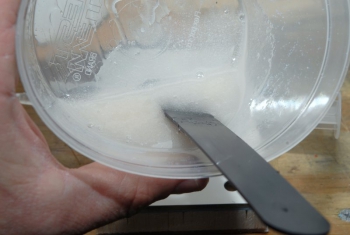
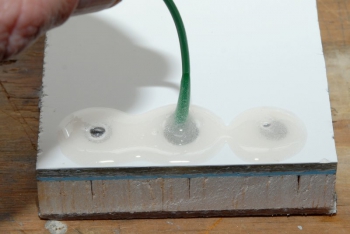
Remove Trapped Air Bubbling
Here I have re-injected the holes with my West System syringe. I did cut about .five cm off the tip of the syringe which makes the hole bigger to adapt the more viscous thickened epoxy.
TIP: The light-green stick you see is simply a piece of weed-whacker line. This is a very simple and cheap tool for popping any trapped air bubbles and aiding in migrating bubbling to the surface so y'all leave behind whatever voids.
All you exercise is move the weed-whacker line in, out and effectually the hole until you have no more air bubbling rising to the surface.
Tape Off The Deck
In this photograph I've actually taped off the deck side to bear witness what it will expect similar. You tin apply an X-Acto knife or a countersink spun between your fingers to get a clean hole. Taping prevents you from needlessly having to clean up epoxy remainder which tin be very difficult if non incommunicable in one case cured.
You'll likewise discover the syringe filled with the thickened epoxy ready to go.
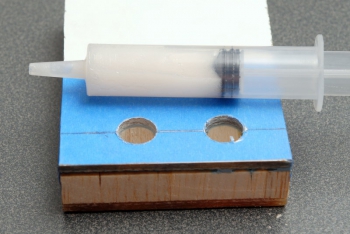
Wipe Information technology Down
Of course if I were doing this on an actual boat I would have start pre-taped over the holes, like the photo higher up, & so used my countersink bit betwixt my fingers to remove the tape from the holes. This method protects the deck and the countersink carves out a nice clean hole in the tape.
In this photo I just used a rag with Acetone to wipe abroad whatsoever over menstruation. Use tape and it will go much smoother and cleaner. I just forgot when photographing this..
The Tape Side of the Deck
In this photo the epoxy has cured and I've removed the duct record. It sealed perfectly and was not affected by the curing resin.
TIP: Before applying the tape, wipe the surface make clean with acetone or a strong solvent that will remove any grease or wax. The tape will seal and stick better. Gorilla brand duct tape is almost the most adhesive you will notice and works really well for this particular chore.
#654 Bit – Cut-A-Way of Potted Deck Hole
Later I removed the record I re-drilled each of the holes with my one/4″ drill and and then counter sunk the two holes that had been potted.
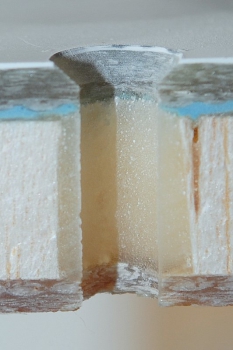
This is a picture of the hole I made with the one/4″ #654 Dremel bit. The hole is clean and precise with plenty of separation betwixt the epoxy and the cadre. Both the summit and bottom holes through the deck skins remained at 1/iv″ for a manufacturing plant original look and experience yet this is much amend than how it would have come from the factory.
#115 Chip – Cutting-A-Way of Potted Deck Pigsty
This is the cutting-a-fashion of the hole I cored out with the #115 bit. If you'll discover the epoxy potting is a little thicker than with the #654 bit. I don't feel this serves much of a purpose, & both will seal the deck from future moisture, but does require slightly more work in the over sizing of the superlative hole to five/16″ or what always size you cull.
When you re-drill your holes, later filling them with epoxy, try and exercise a amend job than I did of centering your bit over the original hole or your deck hardware might not line up over again.
This re-drilled pigsty is off set to the left a trivial flake. Please exist conscientious when drilling over sized holes as it makes re-drilling that much more hard.
TIP: When in uncertainty for the re-drill mark the center points of all your holes using the deck hardware as a template.
Explanation of Countersinking
"RC why on Earth do you countersink or chamfer the deck?"
#1 It does a lot to prevent gelcoat crazing. By feathering the edge of the gelcoat, through the use of countersink scrap, yous are less probable to kickoff a crack or craze mark in the gelcoat.
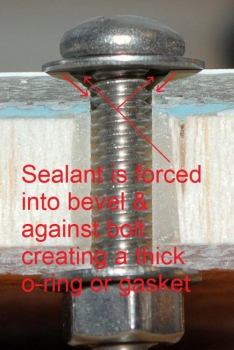
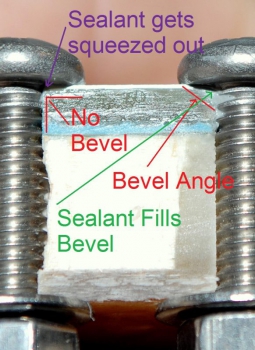
#ii Past creating a bevel or countersunk recess in the surface of the deck the marine sealant or Bed-It Tape has a crenel to fill up. Without a bevel the hardware would compress the sealant to about 1/64th of an inch thick later on the fasteners are tightened. Marine sealants do have some flexibility only not as much as y'all would gauge.
Follow me for a moment:
Let'due south say y'all have a marine sealant that has a rating of 400% elongation before break on a 1/64″ thick articulation. Doing the math shows us that 400% of 1/64″ is only 1/xvi″ of total allowable joint movement earlier a articulation failure or leak starts. In the example of a stanchion base of operations 1/16″ is non much allowable motility before a sealant failure.
By countersinking effectually the commodities holes you'll increase the maximum thickness of the sealant, at the bevel, to roughly a iii/32″ depth at it's deepest bespeak. Using the same math as above 3/32″ 10 400% gives you a total articulation movement before failure of three/8″. If a mechanically fastened joint is moving 3/8″ you lot have more problems than just a deck leak. So, 1/xvi″ allowable movement before failure at 400% without countersinking or three/viii″ allowable movement at 400% before failure with countersinking.
Even a pocket-sized bevel will drastically increase max allowable move before a sealant failure. Countersinking to a mere i/16″ depth volition give y'all 1/four″ total movement around the bolt before failure. You don't demand a deep bevel to brand a large difference between a failure and a seal.
#iii Countersinking is really a very unproblematic step and has numerous benefits. For case, you can install the plumbing fixtures and tighten information technology down at present with no waiting. This means you can seal deck hardware alone and not wait for a marine sealant to change states or cure.
I am going to inject some potent opinion here so please move on to the next photo if you don't want to hear it. I would discourage anyone from using the Don Casey "2 stride", "wait to tighten and form a gasket" method of bedding deck hardware with a curing marine sealant.
Is this because it can't or won't work? Absolutely not? Is it because I don't like Don Casey? Absolutely not! Don is a great guy and tremendous asset to the boating customs. And so why?
In my experience this method is probably i of the leading causes of deck core rot on the planet. This is Non to say that when washed properly it won't work, just that information technology is VERY, VERY, VERY, VERY hard to actually do this properly. Many a DIY and pro have messed this up and ruined decks every bit a result.
Call up nigh it:
If the sealant cures, to course a gasket, and you so movement the bolt while tightening information technology down on the second step…. You volition likely lose. If you create a gasket too thick, it cures, and and then you can't go the mechanically fastened hardware tight enough, against the deck, because of compression resistance, the hardware will move, flex and also fail, so again, you lost the battle.
I hateful no disrespect to Mr. Casey, he writes tremendous marine books and articles, but the method he made popular is very difficult to nail down repeatably because cure-rates change with humidity, temp and far too many factors to get a good reliable process you can easily echo.. I take witnessed far too many cases of core rot due to DIY & professionals using a 2-step bedding procedure than I would have liked to.
So where did I lean this countersinking method? I learned it from Hinckley Yachts… Sure this extra stride takes all of about 30 seconds per stanchion but apparently it'southward too much extra work for nigh production builders.
Stretch….!
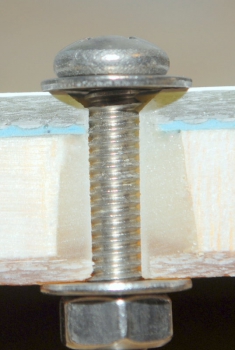
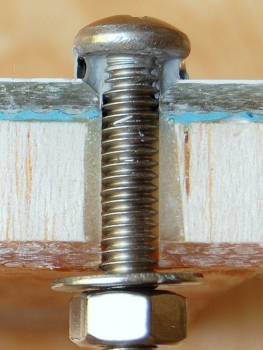
In this photo I used Bed-It Record every bit a bedding compound, it's what I use on about 95% of my deck fittings. I loosened the nut and pushed the bolt up to prove how much commanded movement can be had with a countersunk hole.
If you look close you'll run into that the outer edges, where the bolt head meets flat deck, the sealant has begun to fail or failed entirely yet the Bed-It Record, in the countersunk recess, is all the same stretching and still there. The Bed-It Tape is as well nonetheless well adhered to the threads from existence compressed by the bevel when tightening the bolt.
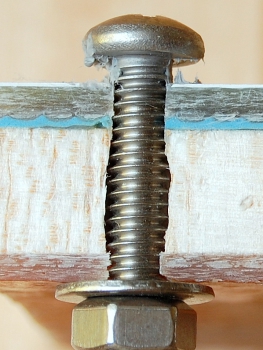
Non Much Stretch
This bolt pigsty has no bevel at the deck level. It was loosened and raised the aforementioned amount equally the previous commodities, to illustrate how much difference in allowable motility one can accomplish through the simple step of countersinking.
Another Analogy
Here you can see how the countersunk hole on the right has forced & compressed the Bed-It Tape against the bolt and into the threads creating a great seal. The bolt on the left was not countersunk and has very piddling sealing surface area effectually the bolts shank or threads.
Alternative Methods
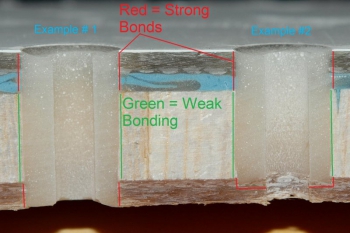
This photo represents two other ways of doing the same job. Personally I'm not a huge fan of either one as much as the previously mentioned methods using the Dremel bits.
Why don't I like these methods as much?
#1 In method #1 I drilled an over sized one/2″ pigsty clean through the deck and so filled information technology with thickened epoxy. Past over drilling the entire thickness yous take removed the deck skins which are the major structural component in the I-beam. Finish grain balsa has very little force along the grain, which is where the epoxy adheres to in an over drill. Picture splitting fire wood. You split up with the grain and if flakes off nicely. Epoxy adhered forth the grain tin practice the same.
If yous tried to split beyond the grain or pull balsa apart via the end grain information technology would exist very, very difficult and this is why information technology is called cease grain balsa and why the deck skins are laminated to the finish grain non parallel to the grain of the woods.
The areas highlighted in red, the deck skins, are thinner than they announced in this cropped photo, especially on lite weight sailboats. In this example your only means of structural support are the circumferential bond between the pinnacle and bottom skins as the expanse in green is very, very weak comparatively speaking and would actually rely on the backing plate.
I have seen ii failures of total over drills in my life. Theoretically speaking, when used with proper backing plates it should hold but if your balsa is even just moist your entire bond will just be the sparse expanse of the two skins. It should be noted that epoxy does not adhere well to wet core this is why it is disquisitional to seal the deck before information technology gets wet.
#ii In method #2 I have but over drilled the top skin just left the bottom skin intact. This is stronger than method #i. With the top skin gone information technology besides is less strong than leaving about or all of the elevation and lesser skins intact and creating a captured plug.
#three Using either method #1 or #ii leaves you with a larger hole on the UV side of the deck. Some stanchion bases or hardware may non entirely cover the larger hole completely and epoxy does not similar UV. This ways an boosted step of gel coating the repair.
It's entirely up to y'all how you seal your decks all I can do is present the pro'southward and cons, as I see them. Of these two methods I prefer method #two but I nonetheless prefer the Dremel procedure far and in a higher place both methods #1 & #2.
That said Any of these methods is far superior to not sealing the core off from potential leaks.
Channeling & Voids
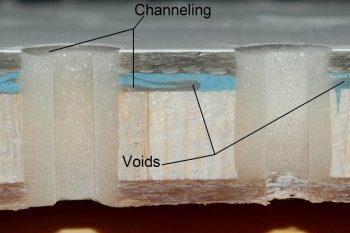
In my years working on boats I have yet to see any cutting up department of hull or deck, unless fabricated using vacuum bagging/resin infusion or SCRIMP, that does not take some voids in it. I will go and so far equally to say that I know of no builder, who hand lays a hull or deck, where having no voids is fifty-fifty 100% possible.
Many builders also utilize thickened resin or "deck putty", as they oft refer to it, on the back side of the hull or deck pare to lay the balsa into during lay up. If this begins to kick, or the balsa in non padded down plenty, there will exist voids. Voids atomic number 82 to channeling of epoxy, or h2o for that thing.
Why do I bring this upwards?
I took this photograph to testify what is happening when you fill a hole with epoxy and come up back v minutes later to detect it has settled. No, the epoxy fairy has not wandered off with your epoxy information technology has channeled into the deck.
The reality is the epoxy has did non in fact settle, unless the record failed, but rather it has channeled into the kerfs or voids in the balsa or deck putty. If this happens, y'all'll need to wait about 30 minutes then mix upward another batch to re-fill or top off the holes. Don't allow the epoxy cure entirely or you'll need to remove the amine blush and this can be a royal pain especially in a small deck hole.
Practiced luck and happy boating!
Source: https://marinehowto.com/sealing-deck-penetrations-to-prevent-core-rot/
0 Response to "what should i use to bed my stanchins on y sailboat"
Postar um comentário